Overdue Strata Levies: Who Can Approve Payment Plans?

Under the Strata Schemes Management Act 2015 (NSW) (SSMA), an owners corporation and a lot owner can enter into a formal payment plan to pay off overdue strata contributions in manageable installments.

While lot owners have the right to request a payment plan, an owners corporation is not legally obligated to accept every proposal and may reasonably refuse a request. However, owners corporations must exercise caution: adopting a blanket policy of automatically refusing all payment plan requests is unreasonable and non-compliant with strata governance standards.

Under the Strata Schemes Management Regulation 2016 (NSW) (SSMR), an owners corporation or strata committee must provide a formal written response within 28 days of receiving a completed payment plan request from an owner.

The Legal Gap: Who Has the Authority to Decide?

Importantly, neither the SSMA nor the SSMR explicitly specifies who within the scheme’s governance structure must make the decision to approve or refuse a proposed payment plan.

There is no statutory requirement that payment plans can only be determined by the owners corporation at a general meeting, nor is there a requirement restricting the decision strictly to a strata committee meeting. Equally, the legislation contains no prohibition against delegating this decision-making authority to a strata managing agent.

Because the legislation remains silent on a single designated decision-maker, authority typically falls to one of three entities.

1. The Owners Corporation at a General Meeting

The owners corporation holds ultimate decision-making power for the scheme. It can vote to approve or refuse a lot owner’s payment plan proposal by ordinary resolution at an Annual General Meeting (AGM) or Extraordinary General Meeting (EGM).

2. The Strata Committee

The strata committee is empowered to exercise the functions of the owners corporation, provided those decisions do not run counter to a decision of the owners corporation or involve matters restricted by law or by a resolution of the scheme. Unless the owners corporation has specifically restricted the committee’s power regarding financial recovery, the strata committee can formally vote on and decide a payment plan request.

3. The Strata Managing Agent

A strata managing agent can approve or refuse a payment plan if the relevant authority has been expressly delegated to them through their agency agreement or a resolution of the owners corporation or strata committee. So long as that delegated authority remains active and has not been limited or revoked the agent can legally act on behalf of the scheme to resolve levy payment plan requests.

Determining Your Scheme’s Decision-Making Authority

Whether a strata managing agent, strata committee, or owners corporation holds the legal standing to sign off on a payment plan depends entirely on the specific governance arrangements, agency contracts, and delegated authority instruments of that particular scheme.

Failing to follow correct delegation rules or missing the statutory 28-day response window can complicate levy recovery actions and expose schemes to unnecessary disputes at the Civil and Administrative Tribunal (NCAT).

Need Expert Guidance on Strata Levy Recovery and Compliance

Recovering overdue levies requires a balanced approach: protecting your scheme’s finances while remaining strictly compliant with statutory frameworks.

Our specialist team provides plain-English legal support for owners corporations and strata managers. We assist with:

  • Levy Recovery Service: Full end-to-end management so you can focus on running your scheme.

  • Delegated Authority: Clear policies and frameworks for managing payment plans.

  • Governance Reviews: Ensuring your processes align with NSW strata legislation.


Levy Debt Recovery: Expert Advice or End-to-End Management

Need Expert Strata Law Advice?

Whether you are navigating a complex dispute or looking to protect your scheme, our specialist NSW and Sydney strata lawyers are here to help. We provide clear, practical advice on all aspects of strata law, including by-laws, strata disputes, building defects, and fast levy debt collections. Call our team on 02 9562 1266 or email us here today.


NCAT Expands Possibilities for Recovering Costs in Strata

Matters dealing with strata and community title disputes in NCAT are normally heard in the Consumer & Commercial Division of that Tribunal. In that Division, leave of the Tribunal is required for a party to be legally represented. Further, the question of legal costs is governed by Section 60 of the Civil & Administrative Tribunal Act which determines that such costs are payable only when “special circumstances” apply.

Sometimes the Tribunal refuses leave for an owners corporation to be legally represented (particularly if an Applicant lot owner is not legally represented) and it has been generally understood that in those circumstances the owners corporation is unable to recover any legal costs which it incurs in preparing for those proceedings.

NCAT Decision: Recovering Preparation Legal Costs Without Leave for Legal Representation

In a recent decision, Brandes v. Community Association DP No. 270482 (No. 2) [2026] NSWCATAP 225, NCAT’s Appeal Panel determined there was no reason in principle why an owners corporation or community association should not be entitled to claim legal costs incurred in assisting it to prepare for a hearing, including assisting a party in drafting documents which are required by the Tribunal.

This means that, in theory, an owners corporation or community association which is required to appear at proceedings in NCAT itself because leave for legal representation has not being granted, can still engage legal advisors to assist it with preparation of materials required by NCAT, including documents and submissions and, provided the “special circumstances” test is met, can make an application that its opponent pay its legal costs of those proceedings.

Proving ‘Special Circumstances’ Under Section 60 of the NCAT Act

In the Brandes decision (and in any case where a party is making an application that the other party pay its legal costs), it is still necessary to demonstrate that “special circumstances” exist that warrant the making of a costs order, as normally each party is required to pay its own costs. In this case the Tribunal determined there were “special circumstances”, as it found the Appellant’s case was weak and misconceived and, therefore, there were special circumstances identified in Section 60(3)(e).

Key Takeaways for Owners Corporations and Strata Managers

This case identifies that a successful owners corporation or community association should consider the possibility of making an application for costs in NCAT proceedings even if it has not been granted leave to be legally represented in those proceedings. Although it may not recover all its legal costs as part of the costs assessment process, if it can demonstrate that “special circumstances” exist, then it may be able to recover a significant portion of those costs.

Need Expert Legal Guidance on Your NCAT Strata Dispute?

Navigating NCAT proceedings and seeking legal cost recovery requires strategic advice tailored to your specific situation. Whether your Owners Corporation or Community Association is preparing for a Tribunal hearing or considering a costs application, our experienced strata law specialists are here to guide you every step of the way.


Speak to an NCAT Strata Law Specialist


Warwick van Ede Executive Council Strata Specialist and Accredited Property Lawyer

Warwick van Ede I BEc LLM I Executive Counsel

Since 1990, Warwick has specialised in strata law, property law and litigation. Recognised for his expertise, he is also a NSW Law Society Accredited Specialist in Property Law. In 2021 he was selected to serve on the Property Law Committee of the Law Society of NSW.  Profile I LinkedIn

Need Expert Strata Law Advice?

Whether you are navigating a complex dispute or looking to protect your scheme, our specialist NSW and Sydney strata lawyers are here to help. We provide clear, practical advice on all aspects of strata law, including by-laws, building defects, and fast levy debt collections. Call our team on 02 9562 1266 or email us here today.


Defining the “Unfinancial” Owner & Their Voting Rights

Being an unfinancial owner has consequences that extend well beyond losing the right to vote at a general meeting.

What is an “Unfinancial” Strata Owner?

A common misconception is that an owner is only unfinancial if they have not paid their strata levies. That is not correct.

An unfinancial owner is an owner of a lot in a scheme who has not paid:

  • All contributions (levies) that are due and payable.
  • Any other amounts that are recoverable from the owner by the owners corporation in relation to their lot.

This means an owner may be unfinancial even if all levies have been paid. An owner may also become unfinancial if they owe other amounts that the owners corporation is legally entitled to recover, such as:

  • Approved interest on overdue amounts.
  • Legal costs that are recoverable under the legislation.
  • Other valid charges properly imposed.

When Can an “Unfinancial” Strata Owner Vote?

In most cases, whether an owner is entitled to vote or stand for election is determined by their financial status when notice of the relevant meeting was given and whether all outstanding amounts were paid before the meeting.

Restrictions on Voting and Committee Eligibility

An unfinancial owner faces the following restrictions:

  • General Meetings: They cannot vote on ordinary or special resolutions at a general meeting (although they may still vote on a proposed unanimous resolution).
  • Strata Committee Nominations: They are not eligible for election or appointment to the strata committee if they were unfinancial when notice of the general meeting was given and remain so at the general meeting.
  • Committee Meetings: A person cannot vote at strata committee meetings if they are an unfinancial owner at the date the notice of the strata committee meeting is given, or if that person was nominated to the strata committee by an unfinancial owner, and the amounts owed to the owners corporation are not paid before the meeting.

Retained Rights of “Unfinancial” Strata Owners

However, an owner does not lose every right because they are unfinancial:

  • They may still require a motion to be included on the agenda for a general meeting.
  • If they are already a strata committee member, they do not automatically vacate office merely because they later become unfinancial.

Case Study: Donne v The Owners – Strata Plan No. 86457 [2021] NSWCATCD 118

You do not have to look much further than the case of Donne v The Owners – Strata Plan No. 86457 to see how strictly the legislation can operate.

In this case, the owner had paid more than was required into the capital works fund but still owed contributions to the administrative fund. The NSW Civil and Administrative Tribunal (Tribunal) considered whether the surplus in one fund automatically satisfied the shortfall in the other.

The Tribunal held that it did not. Until the contributions levied to the administrative fund were paid, the owner remained unfinancial—notwithstanding that they had overpaid into the capital works fund—and interest was charged on the outstanding contributions.

The Tribunal’s Ruling: Although the Tribunal ultimately ordered that the surplus be transferred to satisfy the outstanding contribution and relieved the owner from paying interest, it nevertheless found that the owner was unfinancial on the date of the last annual general meeting. As a result, the owner was not entitled to vote at the meeting, could not vote on the motions before the meeting, and was not eligible to nominate for election to the strata committee. The Tribunal therefore refused to invalidate the resolutions passed at the meeting.

Key Legislative Update (December 2023)

It should be noted that at the time of the hearing in Donne, the Strata Schemes Management Act 2015 did not allow unfinancial owners to nominate a person for election as a member of the strata committee.

This was changed in December 2023. Now, even if an owner is unfinancial, that owner can still nominate a person for election as a member of the strata committee.

Summary for Owners Corporations and Lot Owners

Whether an owner is financial is determined strictly by their position at the time of the meeting. Subsequent orders or adjustments to the accounts will not necessarily alter their voting eligibility retrospectively.

  • For Owners Corporations: It is highly important to ensure that financial records are completely accurate before determining whether an owner is eligible to vote.
  • For Lot Owners: It is equally important to understand that paying levies alone may not be sufficient to remain financial if other recoverable amounts remain outstanding.


Need Expert Assistance with a Strata Dispute or Levy Debt Recovery?

Need Expert Strata Law Advice?

Whether you are navigating a complex dispute or looking to protect your scheme, our specialist NSW and Sydney strata lawyers are here to help. We provide clear, practical advice on all aspects of strata law, including by-laws, building defects, and fast levy debt collections. Call our team on 02 9562 1266 or email us here today.


Renovation Rush: Need a Renovation By-law Fast?

The arrival of a new financial year brings two distinct waves of renovation requests across every strata scheme:

  1. Investors and Landlords: Pushing for upgrades to maximise their tax deductions before the end of financial year and getting ready for new financial year.
  2. Owner-Occupiers: Looking to refresh their living spaces for the year ahead.

For strata managers and committee members, balancing these requests quickly while keeping the building compliant is a high-wire act. Especially as we navigate the progressive change of reform under current NSW strata laws. Without a formally registered Renovation By-law, both types of owners face severe hidden risks that can derail their property goals.

The Risk for Investors: Tax & Insurance Vulnerability

Enthusiastic landlords frequently rush into property updates without realising that generic committee permissions do not offer true legal security.

  • The Insurance Trap: If a new hard flooring installation or layout modification causes issues down the track, building insurers often deny coverage if the work isn’t backed by a registered, official by-law.
  • The Sale Block: When an investor decides to sell, an astute buyer’s strata search will flag undocumented work. Without a registered by-law attached to the lot’s title, the sale can easily stall or fall through completely.

The Risk for Owner-Occupiers: Liability & Compliance Exposure

While owner-occupiers are generally upgrading for lifestyle rather than tax benefits, they face a different kind of legal exposure under the current rules.

  • The Maintenance Liability: By default, the owners corporation is responsible for common property. If an owner updates a bathroom or kitchen and accidentally affects common property structure or waterproofing, they can be held personally liable for thousands in structural repairs.
  • The Strict Turnaround Rule: For minor renovations, committees face tight legislative turnaround times for approvals. Mismanaging this process can lead to unauthorised works, building disputes, and costly NCAT litigation.

What if the work is already done without a by-law?

If an owner renovated in the past without formal approval, it is not too late to rectify the situation. A retrospective renovation by-law can be put in place to fix the paperwork, regularise the works, and protect the property’s title before it sparks a dispute or ruins a future sale.

Need a Compliant Renovation By-Law FAST?

At JS Mueller & Co Strata Lawyers, we specialise in robust, plain-English renovation and retrospective by-laws that clarify exactly who is responsible for what. We guarantee compliant by-laws tailored to the current 2026 laws fast!


CLICK HERE FOR A COMPLIANT RENOVATION BY-LAW FAST


Adrian Mueller Partner JS Mueller & Co Lawyers specialising in Strata Law Sydney and NSW

Adrian Mueller I BCOM LLB FACCAL I Partner

Since 2002 Adrian has specialised almost exclusively in the area of strata law. His knowledge of, and experience in strata law is second to none. He is the youngest person to have been admitted as a Fellow of the ACSL, the peak body for strata lawyers in Australia. Profile I Linked

Need Expert Strata Law Advice?

Whether you are navigating a complex dispute or looking to protect your scheme, our specialist NSW and Sydney strata lawyers are here to help. We provide clear, practical advice on all aspects of strata law, including by-laws, building defects, and levy collections. Call our team on 02 9562 1266 or email us here today.


New EV Strata Laws: Threatens Power Capacity

Strata EV Charging Trap: Deemed Approval Threatens Building Power Capacity

The landscape for electric vehicles (EVs) in New South Wales is undergoing a quiet but rapid shift. Under the Strata Schemes Legislation Amendment (Miscellaneous) Bill, a statutory ‘Right to Charge’ introduces a profound mechanism for owners corporations: the deemed approval.

The premise is simple, plain English. A lot owner can formally request to install an EV charger in their allocated car space. If the strata committee does not provide a reasonable objection in writing within three months, the request is legally deemed approved. While this cuts through historic red tape, it sets a subtle structural trap for the unprepared.

How Does the ‘Right to Charge’ Deemed Approval Work?

The mechanics of the new legislation mean that silence or delay from a committee equals consent. Once a formal installation application is submitted by a lot owner, a strict three-month countdown begins.

If the strata committee fails to issue a valid, written, and reasonable objection within that 90-day window, infrastructure approval is automatically granted by default. This structural shift removes the traditional hurdles for pro-EV residents, but it places a heavy administrative burden on committees to act decisively and quickly.

The Switchboard Capacity Trap for Strata Committees

The true risk for strata committees rarely lies with the first or second request. An early applicant installs their charging unit seamlessly, drawing on the building’s existing power allocation. The real crisis occurs at the fifth, sixth, or tenth request, when the main switchboard suddenly hits maximum capacity.

Approving installations on an ad hoc, first-come, first served basis is a recipe for future financial inequity, structural gridlock, and highly complex legal disputes between neighbours. 

When electrical capacity runs out, the next owner in line faces a staggering cost to upgrade the building’s main infrastructure, an expense that should never fall on a single individual, yet cannot easily be absorbed by the capital works fund without prior planning. Without a clear framework, committees risk gridlock – either shutting down future green energy access or exposing the building to unmanaged infrastructure risks.

Why Owners Corporations Need an EV Infrastructure Master Plan

To navigate the progressive change of reform, owners corporations must move away from reactive decision-making. The solution lies in establishing a comprehensive, forward-thinking framework before the three-month clock starts ticking on individual applications.

A proactive master plan assesses total building capacity, outlines technical integration requirements, and establishes fair rules for access before the switchboard hits its limit.

Safeguard Your Building’s Capacity: Custom EV Infrastructure By-laws

Do not let individual installations compromise your common property. A custom-drafted EV Infrastructure By-law establishes a clear master plan, it:

 – Safeguards your building’s electrical capacity
 – Regulates technical standards
 – Clarifies exact cost recoveries for electricity consumption and maintenance
 – Ensures your committee stays ahead of the legislative clock

Contact our specialist strata legal team today to arrange an EV framework and by-law review.


CLICK NOW TO ARRANGE YOUR EV FRAMEWORK AND BY-LAW REVIEW


Adrian Mueller Partner JS Mueller & Co Lawyers specialising in Strata Law Sydney and NSW

Adrian Mueller I BCOM LLB FACCAL I Partner

Since 2002 Adrian has specialised almost exclusively in the area of strata law. His knowledge of, and experience in strata law is second to none. He is the youngest person to have been admitted as a Fellow of the ACSL, the peak body for strata lawyers in Australia. Profile I Linked

Need Expert Strata Law Advice?

Whether you are navigating a complex dispute or looking to protect your scheme, our specialist NSW and Sydney strata lawyers are here to help. We provide clear, practical advice on all aspects of strata law, including by-laws, building defects, and fast levy collections. Call our team on 02 9562 1266 or email us here today.


Strata Waste & Batteries: Legal, Fire & Insurance Risks

With the rapid rise of battery-powered devices from smartphones to e-bikes owners corporations are increasingly facing a modern and potentially dangerous dilemma: should strata schemes provide dedicated on-site battery disposal facilities for residents?

The answer, from a fire safety perspective alone, should give every strata committee serious pause. Lithium-ion batteries are one of the fastest-growing causes of catastrophic residential building fires.

A communal collection box might seem like a helpful, proactive initiative, it is a move fraught with fire, legal, insurance, and safety liabilities that no owners corporation should take lightly.

Here’s what schemes need to know about their fire safety obligations, legal responsibilities, and the risks of managing battery waste on common property.

Onsite Battery Disposal: Is it Legally Required?

The short answer under New South Wales strata law is no. There is no legislative requirement forcing an owners corporation to provide a battery disposal facility inside a strata building.

While the Strata Schemes Management Act 2015 (NSW) obliges schemes to manage health, safety, and proper waste control on common property, this does not extend to mandating specialist infrastructure for hazardous or problem waste.

Individual resident responsibilities: Under standard council frameworks and EPA guidelines, the responsibility for safely disposing of batteries rests entirely with the individual resident.

Strictly Prohibited from Standard Bins: Batteries are a major fire hazard – they are strictly prohibited from being thrown into standard kerbside red, yellow, or green bins. Instead, residents are expected to take them to designated community recycling drop-off points, such as retail B-cycle points or local council Community Recycling Centres.

The Fire Risk: Why Lithium Batteries Are Uniquely Dangerous

Lithium-ion batteries are found in an enormous range of everyday items – smartphones, laptops, vapes, power tools, e-bikes and e-scooters and they pose a fire risk unlike almost any other household item. Strata committees must understand this risk clearly before making any decisions about on-site battery handling or storage.

Thermal Runaway: A Fire That Cannot Be Stopped

The principal danger is a chemical process known as thermal runaway. When a lithium-ion battery is damaged, punctured, crushed, exposed to heat, or simply reaches the end of its usable life and begins to degrade internally, it can enter an uncontrollable self-heating cycle. This is not an ordinary fire. Once thermal runaway begins it:

  • Accelerates rapidly and is self-sustaining
  • Produces toxic gases
  • Extremely difficult to extinguish

For strata schemes, the conclusion is clear: an unmonitored communal battery collection point is not a recycling initiative – it is a potential ignition point in the heart of a shared building

The Liability Trap: Legal and Insurance Risks

Setting up an unmonitored battery dump on common property, however well-intentioned, introduces substantial risks that strata committees should carefully weigh:

  • Insurance Implications: Strata insurers are acutely aware of these risks. Many now require strict disclosures regarding the storage and charging of lithium-ion batteries. Establishing a communal collection point for dangerous goods without proper infrastructure could jeopardise a building’s insurance coverage or dramatically spike premiums.
  • Work Health and Safety (WHS): By creating a dedicated zone for hazardous waste, a scheme may inadvertently assume a duty of care under WHS legislation. This could necessitate implementing formal handling procedures, installing specialist fire-resistant storage, and providing dedicated training for building managers.

The Challenge for Owners Corporations

The challenge for owners corporations is keeping pace with the progressive change of reform as technology shifts. Ultimately, keeping batteries out of strata waste streams entirely is the safest and most legally sound strategy for any owners corporation with:

  • Targeted Waste Disposal By-Law via special resolution. This by-law clearly shifts the onus, explicitly prohibiting residents from disposing of batteries within the building’s standard waste streams and clarifying that individuals must utilise external recycling facilities.
  • Proactive communication. Committees and strata managers should implement clear signage in common waste areas directing residents to their nearest safe disposal points. A simple reminder to residents to tape over battery terminals and drop them off at local retail collection points can significantly reduce the risk of a catastrophic fire event.

If your owners corporation needs to update existing by-laws or implement a tailored Waste Disposal By-Law or a comprehensive Lithium-Ion Battery Safety By-Law contact our specialist strata team today.


PROTECT YOUR STRATA SCHEME WITH A LITHIUM BATTERY SAFETY BY-LAW


Adrian Mueller Partner JS Mueller & Co Lawyers specialising in Strata Law Sydney and NSW

Adrian Mueller I BCOM LLB FACCAL I Partner

Since 2002 Adrian has specialised almost exclusively in the area of strata law. His knowledge of, and experience in strata law is second to none. He is the youngest person to have been admitted as a Fellow of the ACSL, the peak body for strata lawyers in Australia. Profile I Linked

Contact Us

For all strata law advice including by-laws, building defects and levy collections contact our specialist NSW and Sydney strata lawyers here or call 02 9562 1266, we’re happy to assist.



Fence Disputes: Procedure Matters as Much as Position

Disputes between neighbours about dividing fences are common across New South Wales, particularly where there is disagreement about responsibility or cost of fencing work, or alleged damage, and in cases where years have gone by and the fence has become dilapidated. While emotions often run high in these situations, the legal position is more measured and structured than many expect. 

What is often a simple matter, can become very complex because of the way neighbours react and deal with the dispute.


Understanding the Dividing Fences Act 1991 (NSW)

The starting point is the Dividing Fences Act 1991 (NSW) (Act), which sets out the framework for determining when a sufficient dividing fence is required. What constitutes a “sufficient dividing fence”, and how costs are to be shared, is not always straightforward.


Common Points of Contention and Alleged Damage

A frequent point of contention arises where one neighbour alleges that the other has damaged an existing fence (for example, there is a tree on the neighbour’s property that has damaged the fence) and then that neighbour proceeds to issue a fencing notice seeking contribution for replacement or repair.

Sometimes, a fencing notice is not even served on the other neighbour. It is often assumed that proving fault will entitle the aggrieved neighbour to recover more than the usual 50% contribution to fencing works. However, that is not necessarily the case.


What is a ‘Sufficient Dividing Fence’?

Whether a fence is a “sufficient dividing fence” under the Act depends on a range of factors including the nature of the land, its use, and the character of the locality. The condition of the existing fence is only one part of that assessment.

Where damage is alleged, does that automatically translate into a greater financial obligation on the other neighbour? The question remains whether the fence, in its current state, meets the statutory standard of a sufficient dividing fence and if not, what contribution is reasonable in the circumstances if costs are to be incurred for fencing works.


The Importance of Statutory Procedure

Equally important is the process. The Act requires that neighbours follow certain procedures before carrying out fencing work, including the service of a valid fencing notice and allowing time for agreement to be reached.

Except in genuinely urgent situations, a neighbour who proceeds to carry out fencing work without first complying with these requirements may find it difficult to recover any contribution at all from the other neighbour for the cost of the work, regardless of the merits of their position.


Practical Implications for Neighbours

In practical terms, this means that acting too quickly can undermine an otherwise reasonable claim. Conversely, responding carefully and in accordance with the Act can place a party in a stronger position, whether they are seeking contribution or resisting it.

Fencing disputes often involve a mix of legal, practical, and interpersonal considerations. Whether you are taking an active role in seeking to replace or repair a fence, or responding to a notice from your neighbour, it is important to understand both your rights and your obligations under the legislation.


Expert Advice for Fencing Disputes

Whether you are on the offence or defence, in a dispute and require assistance navigating the process, we can provide clear and practical advice. Do not be caught on the fence.


Have a Fencing Dispute? For Practical Expert Advice Click Here

Contact Us

For all strata law advice including by-laws, building defects and levy collections contact our specialist NSW and Sydney strata lawyers here or call 02 9562 1266, we’re happy to assist.
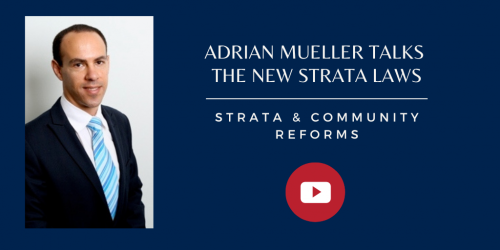


2025-26 Strata Reforms: Our Recent Presentation

With the significant shifts in NSW strata laws that took effect on April 1, 2026, we recently put together a comprehensive presentation from 2025 to 2026 to help simplify what these changes actually mean for you.

Rather than letting these new rules feel like a burden, we want to share the key takeaways from our session to help your committee stay ahead of the curve and keep your building running smoothly.

1. Financial Clarity with 10-Year Plans

The introduction of a mandatory standard form for Capital Works Fund plans is one of the most practical changes we’ve seen.

  • This isn’t just about compliance; it’s about making sure every owner regardless of their background see clearly how their home is being protected for the future. It removes the guesswork of strata finance and replaces it with transparency.

2. Supporting New Communities

For those in multi-storey developments, the law now requires independent certification of maintenance schedules and levy estimates before the first AGM.

  • This is a win for fairness. By ensuring that initial costs are realistic and independently verified, we can help prevent the levy bill shock that often causes friction in new schemes. It’s about building trust from the very first day.

3. A Pathway to Modern Living

The 2026 reforms make it significantly easier for schemes to approve sustainability infrastructure (like EV charging) and disability accessibility upgrades.

  • We’ve noticed that many existing by-laws are now out of step with these new ‘reasonableness’ requirements. We’re helping our clients refresh their documents to make sure they enable these positive improvements while still protecting the collective interests of all owners.

4. Transparency in Utility Supply

If your building uses an embedded network for power or data, this must now be clearly disclosed on Section 184 Certificates.

  • No one likes an unexpected surprise when buying into a building. Clear disclosure at the start ensures a smoother sales process and reinforces a culture of honesty within the scheme.

Presentation: 2025-2026 Strata Reforms

We want to make sure your committee has the right tools to navigate these changes with confidence. So we’re sharing our recent presentation, making insights and materials available to our broader strata community.

Our team is here to help you translate these new laws into practical strategies for your building.


2025-26 Strata Reforms Presentation

Future Proofing You and Your Strata Scheme

Every strata scheme is unique, and these reforms may affect your building in ways a general presentation can’t cover.

If you have questions about how these changes impact your specific by-laws or levy structures, our specialist strata legal team is here to help you navigate the new reforms.


Click Here for Help with the New Strata Reforms


Adrian Mueller Partner JS Mueller & Co Lawyers specialising in Strata Law

Adrian Mueller I BCOM LLB FACCAL I Partner

Since 2002 Adrian has specialised almost exclusively in the area of strata law. His knowledge of, and experience in strata law is second to none. He is the youngest person to have been admitted as a Fellow of the ACSL, the peak body for strata lawyers in Australia. Profile I Linked

Contact Us

For all strata law advice including by-laws, disputes, building defects and levy collections contact our specialist NSW and Sydney strata lawyers here or call 02 9562 1266, we’re happy to assist.



Compliance Alert: Is Your Strata Scheme Up to Date?

The legislative landscape for strata schemes in New South Wales has been fundamentally reshaped by a rolling series of reforms introduced throughout 2025 and into 2026.

For many strata committees and owners corporations, the challenge isn’t just a single deadline; it is keeping pace with a progressive series of reforms designed to foster greater transparency, accountability, and building safety.

We believe that compliance shouldn’t feel legally overwhelming. Instead, it is an opportunity to strengthen your building’s governance and ensure your community operates as harmoniously as possible.

If your scheme is still operating under the assumption of ‘business as usual’, you may inadvertently be carrying hidden legal and financial risks.

The 2025-2026 Reform Roadmap

These changes have been introduced in strategic waves, each addressing different critical areas of strata management:

  • Mid-2025 – The Foundations: Reforms focused on defect management, repair obligations, and streamlined renovation approvals, alongside enhanced accountability for building managers.
  • Late 2025 – Financial & Enforcement focus: Introduction of stronger Fair Trading investigation powers, mandatory financial hardship protections for lot owners, and stricter rules for debt recovery and levy notices.
  • April 2026 – Transparency & Handover: The focus shifted to new developments, requiring standardised 10-year Capital Works Fund Plans, independent certification of levies for multi-storey buildings, and mandatory disclosure of embedded networks.

Why Your By-Laws Need a Review

While these reforms introduce new legal obligations, your building’s by-laws are the mechanism through which these laws are applied on the ground.

If your by-laws haven’t been reviewed in the last 12–24 months, you are likely operating under rules that are outdated, inconsistent with current legislation, or difficult to enforce. A by-law review is not merely a ‘clean-up’ exercise; it is your most effective tool to:

  • Ensure Enforceability: Many older by-laws now conflict with current legislation, rendering them legally unenforceable.
  • Modernise Your Rules: From regulating smart home technology and surveillance privacy to managing EV charging and assistance animals, your by-laws must reflect the realities of modern strata living.
  • Operational Alignment: A review synchronises your internal governance with the 2025–2026 standards, ensuring your committee has the clear, legally sound authority to act on maintenance, financial hardship, and building safety.

Your Compliance Checklist

As we navigate the next phase of reforms later this year (including mandatory committee training and expanded off-the-plan disclosures), use this checklist to assess where your scheme stands:

  • Audit Your Governance: Are your current by-laws aligned with the 2025/2026 legislative changes, or are they relics of the past?
  • Standardise Your Paperwork: Have you transitioned to the new mandatory NSW Government forms for 10-year plans and Initial Maintenance Schedules?
  • Update Financial & Safety Protocols: Do your levy notices include the mandatory financial hardship disclosures, and are your maintenance logs ready for increased scrutiny.
  • Are Your By-laws a Liability? Click here for full overview of the new laws:
    2025-2026 Changes to Strata Laws

Our goal is to make these legal complexities feel manageable, so owners corporations, committee members and strata managers can focus on what matters: the wellbeing of your community.

IS YOUR BUILDING COMPLIANT? BOOK NOW FOR A COMPREHENSIVE BY-LAW AUDIT


Adrian Mueller Partner JS Mueller & Co Lawyers specialising in Strata Law

Adrian Mueller I BCOM LLB FACCAL I Partner

Since 2002 Adrian has specialised almost exclusively in the area of strata law. His knowledge of, and experience in strata law is second to none. He is the youngest person to have been admitted as a Fellow of the ACSL, the peak body for strata lawyers in Australia. Profile I Linked

Contact Us

For all strata law advice including by-laws, disputes, building defects and levy collections contact our specialist NSW and Sydney strata lawyers here or call 02 9562 1266, we’re happy to assist.


Privacy vs Protection in NSW: Navigating Smart Surveillance

In 2026, the smart home is no longer a luxury – it is the standard. From video doorbells and smart locks to digital peepholes, lot owners have more tools than ever to secure their front doors.

However, as technology advances, so does the legal friction between a resident’s right to security and a neighbour’s right to privacy.

With NSW courts and tribunals taking an increasingly strict view on surveillance in high-density living, the line between personal security and unlawful surveillance has never been thinner.

The Rise of Incidental Recording

The Surveillance Devices Act 2007 (NSW) is clear: it is generally an offence to install or use an optical surveillance device to record a private activity without consent. While a lot owner may believe they are simply protecting their lot, the reality is that smart doorbells and locks often capture much more.

In 2026, we are seeing a shift in how these cases are adjudicated. Recent rulings suggest that courts are less likely to accept incidental recording as a valid excuse. If a camera, even a doorbell, captures the movement of a neighbour entering their own lot or records private conversations in a common hallway, it may be deemed a breach of privacy.

The trend is moving toward prioritising the collective privacy of the scheme over the individual lot owner’s desire for outward-facing surveillance.

The Common Property Surveillance Trap

A common misconception is that a lot owner can install a camera on the external side of their front door without permission. In most strata schemes, the external leaf of the front door and the hallway beyond it are common property.

Installing a device on common property without an authorised by-law is not just a privacy issue it is a breach of the Strata Schemes Management Act. Without a formal agreement, the owners corporation can often order the immediate removal of such devices at the owner’s expense.

Why a Proactive By-law is Essential

To avoid residents pointing cameras into each other’s lots or monitoring common areas unchecked, a specific, well-drafted by-law is the only solution.

Without a by-law to regulate the installation and use of CCTV and smart devices:

  • Chaos prevails: Residents may install devices that infringe on the peace and enjoyment of others.
  • Liability increases: The owners corporation could be drawn into expensive NCAT disputes between feuding neighbours.
  • Data remains unregulated: There are no rules on who sees the footage, how long it is kept, or how it is secured.

Protect Your Scheme with a Legally Compliant By-law?

Our legal strata team specialises in drafting comprehensive by-laws that balance modern security needs with strict privacy compliance. A custom CCTV by-law ensures that:

  1. Installation is controlled: Devices must meet specific criteria regarding field of view.
  2. Privacy is protected: Cameras cannot spy into other lots.
  3. Harmony is maintained: Clear rules prevent disputes before they reach the courtroom.

Ensure your scheme is protected by a legally robust framework tailored for the technology of 2026. To discuss a custom by-law for your building. We provide plain-English legal advice to help owners corporations and strata managers navigate the complexities of NSW strata law.


Protect your Scheme with a Legally Robust Surveillance By-law


Adrian Mueller Partner JS Mueller & Co Lawyers specialising in Strata Law

Adrian Mueller I BCOM LLB FACCAL I Partner

Since 2002 Adrian has specialised almost exclusively in the area of strata law. His knowledge of, and experience in strata law is second to none. He is the youngest person to have been admitted as a Fellow of the ACSL, the peak body for strata lawyers in Australia. Profile I Linked

Contact Us

For all strata law advice including by-laws, disputes, building defects and levy collections contact our specialist NSW and Sydney strata lawyers here or call 02 9562 1266, we’re happy to assist.